Grace's recovery and end of her penance
Our Chemical HeartsGrace Town’s recovery unfolds not as a sudden cure but as the gradual end of a private penance. After Dom’s death, she repeatedly pushes her injured leg as though continued pain could repay an imagined debt; over time, she lets go of that punishment, relies less on her cane, and begins to live more fully in the present. The change is visible in her movement and clothing, but it remains distinct from a simple return to how she was before the crash.
Injury and Self-Punishment
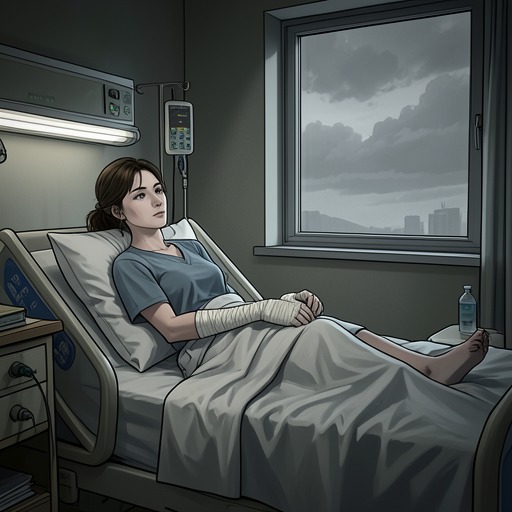
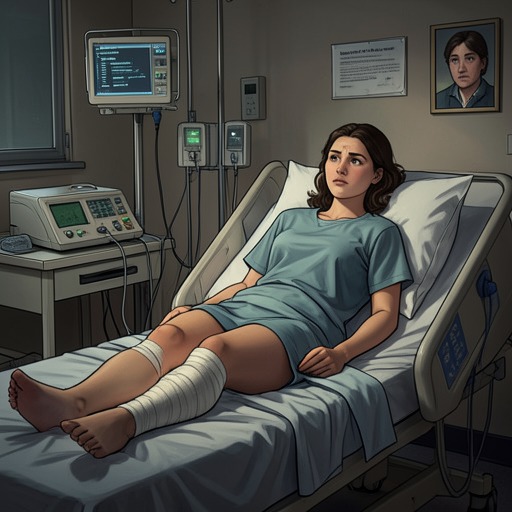
Grace Town first appears at school walking with a cane, a conspicuous sign of the lasting effects of the car accident. Henry Page later learns that her treatment involved skin grafts and pins, and that the injury left her with serious limitations. Her recovery therefore concerns more than her willingness to walk unaided: the story shows a body still marked by injury and a life shaped by its consequences.
At the track at East River High School, Grace Town tries to run without her cane. She manages only a short distance before stopping, then uses the cane against her injured leg and collapses in tears. The episode makes the relationship between physical pain and self-punishment explicit: she is not merely trying to exercise or regain mobility, but testing and worsening an injury that has not healed. The scene also establishes the cost of that effort; her pronounced limp persists.
Henry Page later connects her continued use of Dom’s clothes, her unwashed bedding, and her attempts to keep the injured leg from healing too quickly with a form of atonement. In his understanding, she treats pain as a payment for surviving Dom and as the only justice she can offer him. This is his interpretation of her behavior, rather than evidence that her recovery follows a straightforward medical or emotional course.
Grief, Witness, and Release
After Henry Page finds her, Grace Town rejects the assumption that her grief means she is depressed, describing herself instead as angry. She recalls that, in the month after Dom died, people watched her closely because they feared she might harm herself. Her account exposes a distance between being monitored and being understood: she says Dom was the person who knew her, while Henry recognizes that he had also mistaken other people’s fears for knowledge of her inner life.
At the Abandoned train station, Grace Town returns to the place associated with Dom and brings a small metal box containing objects from his shrine. The keepsakes include the anchor necklace she wore when Henry first saw her, a Strokes keychain, and Dom’s Ramones T-shirt. She takes Henry Page’s hand and releases the objects one by one into the water, then lets the box itself sink. The act does not erase Dom or settle the meaning of her grief; it gives a visible form to her decision to stop keeping his belongings as the center of her daily life.
The gesture belongs to a wider pattern of shared rituals around loss. Earlier, after Ricky Martin Knupps died because the fish’s clay palace was unsafe, Grace Town carried his body in a container in her backpack until lunchtime, when the group held a small funeral under the bleachers and hummed a song as they buried him. That episode is not equivalent to mourning Dom, but it shows Grace participating in a communal act of remembrance. At the station, by contrast, the release of Dom’s belongings is a more private and consequential act, witnessed by Henry.
Gradual Recovery
After Christmas break, Grace Town’s limp becomes less noticeable, and she stops walking with her cane altogether. She starts driving to school. She sometimes still wears an item of Dom’s clothing, including a knit cap, necklace, or jacket, but mostly returns to wearing her own things. These changes arrive gradually, alongside her growing willingness to let the imagined debt go; the narrative presents recovery as a process rather than a single turning point.
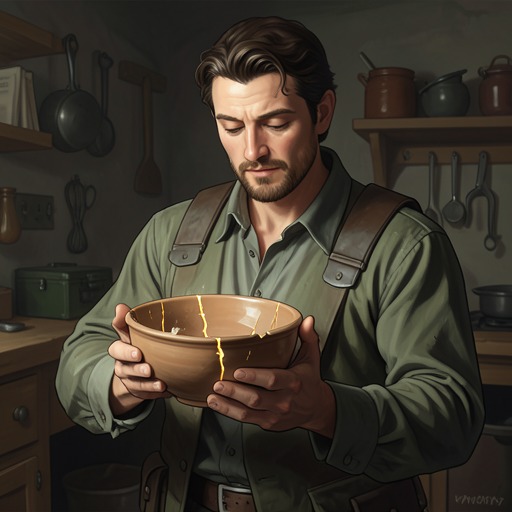
The shift does not mean that memory disappears or that every consequence of the injury is undone. Instead, the story links her improving mobility and changing habits with a reduced commitment to suffering as payment. The golden-seam image of Kintsukuroi gives that development a repair metaphor, while the concrete changes remain modest and specific: a less pronounced limp, no cane, driving, and clothes increasingly chosen for herself.
Relationships and Aftermath
Henry Page supports Grace Town through the period of recovery, but support does not make their relationship permanent. Their connection remains entangled with her grief for Dom and Henry’s wish to be recognized as someone real in her life. The story’s account of Grace’s recovery therefore does not resolve the emotional uncertainty between them; her movement toward a life less governed by penance occurs alongside the eventual separation of their lives.
As her self-punishment eases, the ties between Grace Town and Henry Page are gradually loosened. They delete each other from social media and transfer custody of Ricky Martin Knupps II to Ryan, who renames the fish Fish Fish. The practical handover and the severed online connections mark the end of shared routines, not the disappearance of feeling: Henry continues to love Grace, even as they become separate from one another.
Narrative Significance
Grace Town’s recovery is framed through observable changes rather than a declaration that grief is finished. The cane, the attempt to run, the keepsake box, and the return to her own clothes make the stages of her movement away from self-punishment legible. At the same time, the injury is not simply a symbol that vanishes when she changes emotionally: the story specifies the lasting physical effects and the effort walking requires.
The ending holds recovery and loss together. Grace Town gradually stops treating pain as a debt owed to Dom, but that change neither reverses the accident nor guarantees a happy outcome with Henry Page. Her recovery is consequential precisely because it is incomplete in that sense: she begins to reclaim her own life, while the relationship that witnessed part of that process comes to an end.